Two ant problems dominate Glen Burnie, and they are not the same job. The first is a sugar-and-grease trail — usually odorous house ants (crush one and it smells faintly like a rotten coconut) or pavement ants pushing…
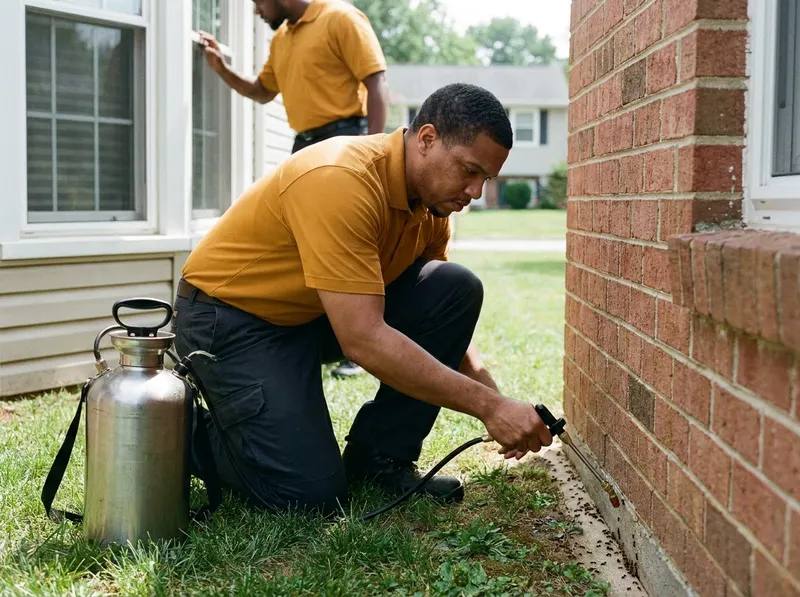
Two ant problems dominate Glen Burnie, and they are not the same job. The first is a sugar-and-grease trail — usually odorous house ants (crush one and it smells faintly like a rotten coconut) or pavement ants pushing up through slab expansion joints and driveway seams. Those colonies live outdoors or in a wall void and forage inside. The second is carpenter ants: large black ants, roughly a quarter to a half inch, that excavate galleries in wood that has already been softened by water. In the older post-war blocks of Harundale and Ferndale, that water is often a leaking hose bib, a clogged gutter dumping against the fascia, or a crawlspace sill plate that stays damp all summer. Closer to the tidal edges of Marley Neck, Point Pleasant and Solley, ambient moisture keeps deck ledgers, shed floors and porch columns attractive year after year. If a treatment ignores the wet wood, the ants come back the next spring.
Here is the identification most homeowners get wrong: winged ants versus termite swarmers. Winged carpenter ants have a pinched waist, elbowed antennae, and front wings noticeably longer than the back pair. Eastern subterranean termite swarmers have a straight body, straight beaded antennae, and two pairs of equal-length wings that drop off in piles on the windowsill. Coarse sawdust-like shavings with insect body parts mixed in means carpenter ants. Mud tubes on a basement joist mean termites, which is a different service entirely. We will tell you which one you have before anyone quotes a plan.
When a single spray-and-go treatment fits: one visible trail, one room, one species, no wood damage, and no history of repeat activity — common in the newer slab townhomes around Tanyard Springs and Cromwell, where pavement ants exploit the joint between slab and stem wall. When it does not fit: multiple trails on different floors, ants reappearing three weeks after every store-bought attempt, or frass and hollow-sounding wood. Repeated retail sprays are the reason many Glen Burnie calls arrive as a multi-room problem — pyrethroid contact killers repel foraging ants and can split an odorous house ant colony into satellite nests, turning one kitchen trail into three. Non-repellent products and slow-acting baits do the opposite: workers carry the material back and the colony dies with the queen.
Before we come out, there is free work worth doing yourself. Pull mulch and soil back three inches from the foundation. Cut tree limbs and shrubs so nothing touches siding or roofline — mature oaks and maples through Furnace Branch and Sunset Knoll act as a bridge straight to the gutter line. Move pet food into sealed containers, rinse recycling, and extend downspouts away from the wall. Along the wooded corridor near Sawmill Creek Park and the northern end of the Baltimore & Annapolis Trail, dead limbs and old stumps within 20 feet of the house are common carpenter ant parent colonies; removing them reduces pressure permanently. If those corrections solve it, you do not need us. For rentals in Freetown and elsewhere in Anne Arundel County, we will document species, entry points and the moisture source in writing so a tenant has something concrete to hand a landlord.
Every job gets a firm, written price after a free on-site visit.
Tell us about your ant control job in Glen Burnie and we'll send a clear, written quote — usually the same day.
 Zorvex Pest Solutions