A mouse fits through a gap the width of a pencil — about a quarter inch. A Norway rat needs roughly half an inch, and will gnaw a smaller hole until it qualifies. That single fact decides how a rodent job in Glen…
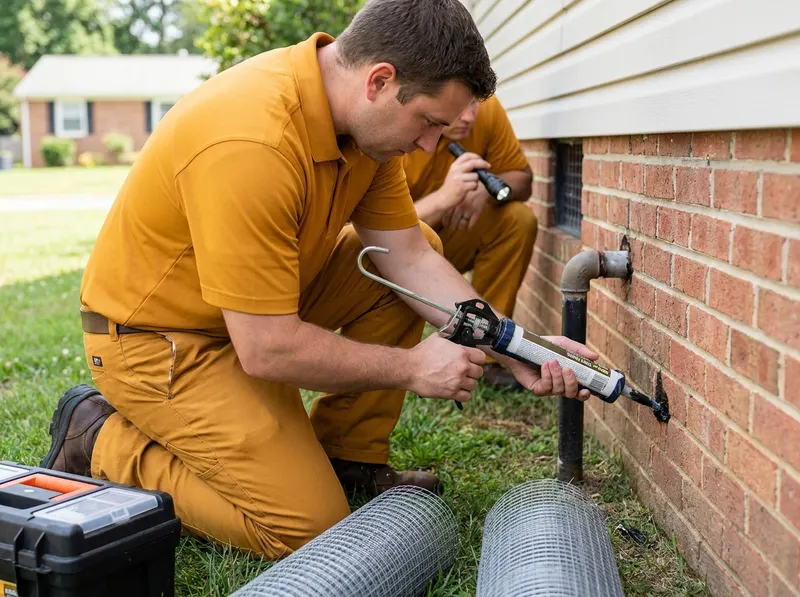
A mouse fits through a gap the width of a pencil — about a quarter inch. A Norway rat needs roughly half an inch, and will gnaw a smaller hole until it qualifies. That single fact decides how a rodent job in Glen Burnie should be run. When we walk a house in Harundale or Furnace Branch, we're on our knees with a flashlight at the sill plate, the water and gas line penetrations, the garage door corners, and the point where the front stoop meets the brick. Post-war housing stock across older Glen Burnie neighborhoods has settled for seventy-odd years, and the gaps that opened up as it settled are the reason mice show up in October in the same houses year after year.
Rats are a different animal and a different job. Along the shed rows and alley edges near Freetown, Point Pleasant, and the stream corridors feeding Sawmill Creek Park, Norway rats live outdoors in burrows and commute — under a deck, into a crawlspace, along a fence line to a bird feeder or a poorly latched trash can. Treating the inside of the house without finding the burrow system is why so many rat 'treatments' fail twice. On rat work we count active burrow openings, look for greasy rub marks on joists and fence boards, and treat the exterior harborage first. In Marley Neck, Solley, and the waterfront pockets of Point Pleasant, damp crawlspaces and settling block foundations give rodents both an entrance and a reason to stay, so moisture and grade get noted in the report even when the fix is a downspout extension rather than a chemical.
Here is the honest decision-fit. If you have one mouse and a newer, tight house — the kind of construction common in Tanyard Springs — you may need trapping plus two or three sealed penetrations and nothing more. That is a small job, and we will tell you that. If you're hearing activity in more than one wall, finding droppings in multiple rooms, or you're a landlord with mice moving between units in Cromwell or Ferndale, trapping without exclusion is renting the quiet. Whole-home exclusion costs more up front and is the only version of this work that actually ends. The trade-off is real: exclusion is labor, ladders, and materials, and it can double the invoice compared to a bait-and-go visit. It also removes the recurring monthly line item most companies are selling.
Things you can fix yourself, free, before we ever arrive: get pet food and bird seed into sealed containers, move the feeder well away from the foundation, close the gap under the garage door, cut back ivy and shrub contact with the siding, and stop leaving trash bags out overnight — that alone changes rat pressure on a Glen Burnie block. We use rodenticide sparingly and, where we do, it goes in tamper-resistant exterior stations away from where children and dogs go. Interior work leans on trapping and sealing, because a rodent that dies inside a wall creates a second problem. Homes across Sunset Knoll, Harundale, and the neighborhoods around the Baltimore & Annapolis Trail's northern trailhead and Glen Burnie Park sit close enough to open ground and rail corridor that seasonal pressure is normal — the goal is a sealed building envelope, not a sterile neighborhood. Diagnosed first. Treated once. Sealed shut.
Every job gets a firm, written price after a free on-site visit.
Tell us about your rodent control and exclusion job in Glen Burnie and we'll send a clear, written quote — usually the same day.
 Zorvex Pest Solutions