Glen Burnie's housing stock makes this a specific problem rather than a generic one. Much of Harundale, Ferndale and Freetown was built out in the 1940s–1960s on shallow crawlspaces and block foundations with little or…
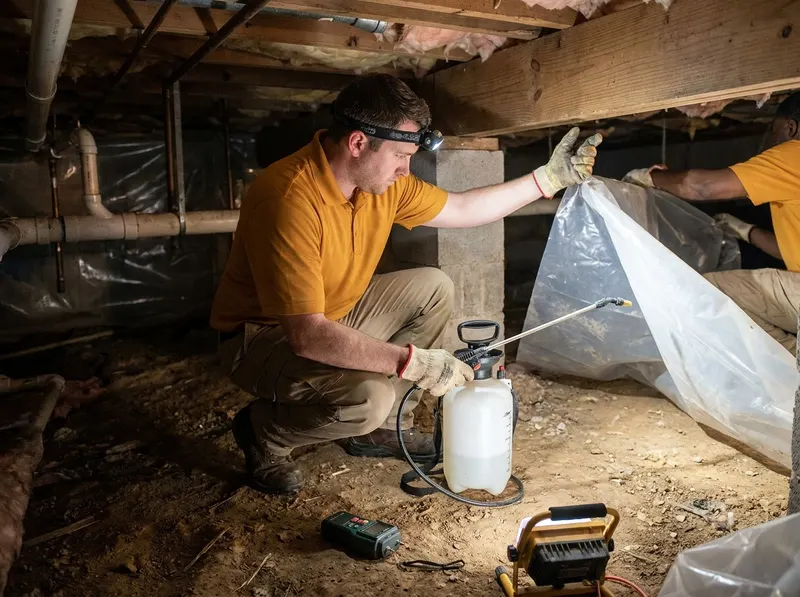
Glen Burnie's housing stock makes this a specific problem rather than a generic one. Much of Harundale, Ferndale and Freetown was built out in the 1940s–1960s on shallow crawlspaces and block foundations with little or no vapor barrier, and the water table in the low ground toward Marley Neck, Point Pleasant and Solley sits close enough to the surface that bare crawl soil stays cool and damp through most of the year. Springtails and sowbugs live in that soil by the thousands. When relative humidity under the floor holds above roughly 60 percent, the population climbs; when a downspout dumps against the block or the grade slopes back toward the house, the population moves indoors. Camel crickets in particular follow humidity gradients, which is why homeowners see them on the basement stairs and in the laundry room rather than in the kitchen.
Here is the honest identification piece. Camel crickets are humpbacked, wingless, tan-and-mottled, jump when startled, and do not bite, sting or damage structural wood — they are unnerving, not dangerous. Springtails are the 1–2 mm specks near a sump pit or shower drain that flick away when disturbed, and they are frequently mistaken for fleas; fleas jump onto ankles, springtails do not. Sowbugs and pillbugs are crustaceans that breathe through gill-like structures and die within hours in dry air, so finding dozens of them dead along a basement wall is itself a moisture reading. None of these three indicate a hygiene problem. All three indicate water.
Decision-fit matters more than the treatment. If your readings show 55–60 percent humidity, a sealed vapor barrier and a graded exterior, a targeted treatment plus exclusion is the right, contained job — the insects are coming in from the yard and belong outside. If the crawl soil is visibly wet, the barrier is torn or absent, insulation is sagging, or joists are dark and damp near a leaking hose bib, then spraying is the wrong purchase. In that case we tell you what to have corrected first: extend downspouts, regrade the drip line, repair the crawl door, replace the barrier, run a dehumidifier drained to a pump. Treating a wet crawlspace on a recurring schedule is paying rent on a problem you could own outright. Some Glen Burnie visits end with a moisture list and no treatment plan at all, and that is a legitimate outcome.
The seasonal pattern is predictable enough to plan around. Spring rains raise the water table across the Furnace Branch and Sawmill Creek drainages and push springtails and millipedes indoors. Mid-summer humidity keeps camel cricket numbers high in unvented crawls. October brings a different crowd — brown marmorated stink bugs and mice pressing toward warmth — which is exclusion work, not moisture work. Sealing is what holds after the spray degrades, so we measure and close crawl-door perimeters, unscreened foundation vents, sill-plate gaps and utility penetrations while we are under the house. Landlords managing units near Cromwell and Sunset Knoll usually want the written moisture list specifically, because it separates a tenant complaint from a building repair.
We work around toddlers, dogs and vegetable beds constantly, and product placement reflects that: crack-and-crevice and rim-joist applications in the crawl, not broadcast spraying of living space. Ask what is being applied and where, and you will get a straight answer before anything is opened. Every price below is a ballpark; the exact figure is confirmed on site after the readings, and the $250 minimum applies to all crawlspace and basement work in Glen Burnie.
Every job gets a firm, written price after a free on-site visit.
Tell us about your crawlspace and basement moisture pest control job in Glen Burnie and we'll send a clear, written quote — usually the same day.
 Zorvex Pest Solutions